Graphing Quadratic Equations
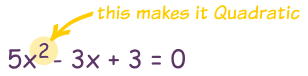
Here is an example:
Graphing
You can graph a Quadratic Equation using the Function Grapher, but to really understand what is going on, you can make the graph yourself. Read On!The Simplest Quadratic
The simplest Quadratic Equation is:
f(x) = x2
And its graph is simple too: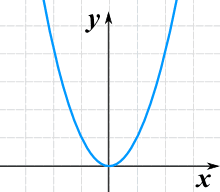
f(x) = ax2
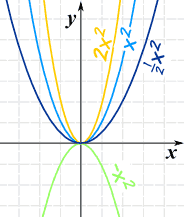
- Larger values of a squash the curve inwards
- Smaller values of a expand it outwards
- And negative values of a flip it upside down
 |
Play With ItNow is a good time to play with the"Quadratic Equation Explorer" so you can see what different values of a, b and c do. |
The "General" Quadratic
Before graphing we rearrange the equation, from this:
f(x) = ax2 + bx + c
To this:
f(x) = a(x-h)2 + k
Where:- h = -b/2a
- k = f( h )
First of all ... Why?
|
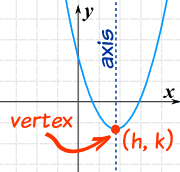
So ...
- h shows us how far left (or right) the curve has been shifted from x=0
- k shows us how far up (or down) the curve has been shifted from y=0
Example: Plot f(x) = 2x2 - 12x + 16
First, let's note down:- a = 2,
- b = -12, and
- c = 16
- a is positive, so it is an "upwards" graph ("U" shaped)
- a is 2, so it is a little "squashed" compared to the x2 graph
h = -b/2a = -(-12)/(2x2) = 3
And next we can calculate k (using h=3):
k = f(3) = 2(3)2 - 12·3 + 16 = 18-36+16 = -2
So now we can plot the graph (with real understanding!):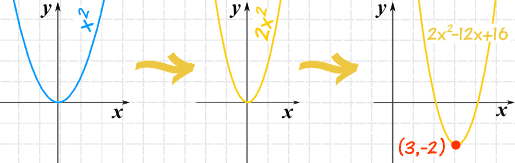
We also know: the vertex is (3,-2), and the axis is x=3
From A Graph to The Equation
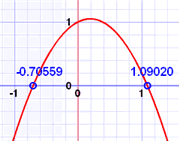
What if we have a graph, and want to find an equation?Example: you have just plotted some interesting data, and it looks Quadratic:
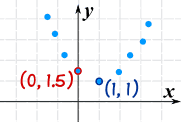
Firstly, we know h and k (at the vertex):
(h, k) = (1,1)
So let's put that into this form of the equation:
f(x) = a(x-h)2 + k
f(x) = a(x-1)2 + 1
Then we calculate "a":| We know (0, 1.5) so: | f(0) = 1.5 | |
| And we know the function (except for a): | f(0) = a(0-1)2 + 1 = 1.5 | |
| Simplify: | f(0) = a + 1 = 1.5 | |
| a = 0.5 |
f(x) = 0.5(x-1)2 + 1
Note: This may not be the correct equation for the data, but it’s a good model and the best we can come up with.

No comments:
Post a Comment